
Teams often feel that too much time is being spent on routine work, but it is difficult to quantify whether change would be justified.
This is where many automation discussions stall. There is a sense that something should improve, but no clear way to evaluate if change would be worth the effort.
Our Viability Checker tool is designed to address that gap. It provides a simple way to assess whether a process change is worth exploring further, without requiring detailed analysis or technical input.
Who this tool is for
This tool is intended for people responsible for how work gets done day to day.
It is most relevant if you are:
- managing a team with a growing administrative workload,
- dealing with processes that have developed over time without clear design,
- seeing repeated tasks handled across multiple people,
- unsure whether automation and AI would actually help.
Typical roles include operations managers, finance leads, founders, and heads of support or admin functions.
The common thread is not technical expertise. It is a need to understand whether time and effort are being used effectively.
What the tool helps you understand
The tool focuses on two practical questions:
- how much time and cost are tied up in manual work?
- is it likely to be worth addressing?
It answers these through a simple two-step approach.
Estimating the scale of effort
The user begins by entering a small set of inputs into our Opportunity Calculator tool:
- team size,
- time spent on manual work,
- average salary.
This produces a clear estimate of how much effort is currently tied up in routine tasks.
It does not aim to be exact. The value comes from turning a vague sense of inefficiency into something visible and comparable.
Assessing whether it is worth solving
From the Automation Opportunity Calculator the user has the option to proceed to The Viability Checker. The Viability Checker asks for some simple context around the process itself. This is simply estimating how often the process occurs, and how complex it would be to change it.
Based on this, the tool provides one of the following directional outcomes:
- likely to deliver value,
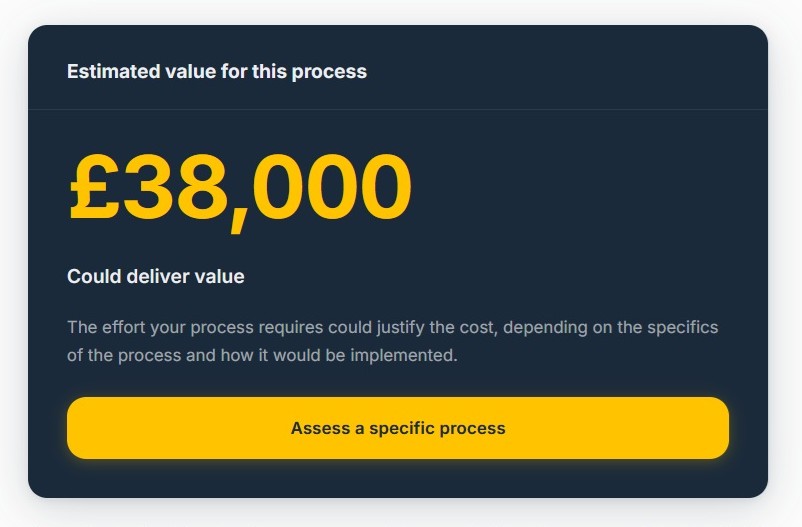
- could deliver value,
- may require refinement.
This gives a structured way to decide whether further work is justified.
How to interpret the results
The output is designed to guide thinking, not to present a precise financial case.
Each outcome has a different implication.
Likely to deliver value This is a strong signal. The process is a good candidate for further exploration and may justify investment.
Could deliver value There is some potential, but the detail matters. A closer look at the process is needed before deciding.
May require refinement As it stands, the process is not a strong candidate. It may still be viable if the scope is reduced or the process is simplified.
What the monetary value represents
The displayed is an estimate of the annual value of time and cost that could realistically be reduced if the process were improved or automated.
This number should not be treated as a precise financial outcome.
It is not:
- a guaranteed saving,
- a detailed forecast,
- or a final business case.
In practice, some work will always remain. Processes vary, and outcomes depend on how any change is implemented.
Many organisations underestimate how much time is absorbed by routine work. At the same time, there is often an assumption that automation will remove more effort than it realistically can.
This figure sits between those two views. It highlights meaningful opportunity while accounting for real-world constraints.
Why this approach works
Automation projects often fail because of the approach they take.
Some go too deep too fast, undertaking detailed analysis before confirming that there is a meaningful problem to be solved at all. Others rely on incomplete information, leading to uncertain or biased outcomes.
This tool allows for an approach which avoids the first of these issues. It attempts to give a simple assessment of whether meaningful value could be saved or generated by automating a particular process.
It also tries to avoid overpromising. Not every process is worth changing, and the tool reflects that.
Where to go from here
If you are considering automation and AI, the first step is not to design a solution. It is to understand whether there is a problem worth solving.
This tool provides a quick way to do that.