
In many organisations, routine administrative work builds up gradually.
It is rarely planned.
Tasks are added over time, spread across teams, and absorbed into daily operations. As a result, the overall level of effort is difficult to see, even when people feel consistently busy.
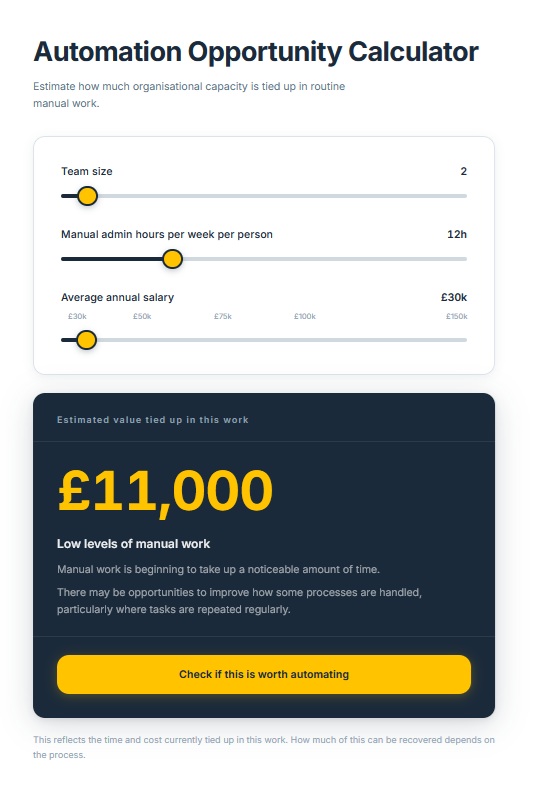
Our Automation Opportunity Calculator is designed to make that effort more visible.
Who this tool is for
This tool is most useful in organisations where work is coordinated across teams, systems, and processes, and where much of that work is still handled manually.
It is particularly relevant to:
- operations leaders who want a clearer view of how time is used day to day,
- business owners and directors who sense inefficiency but cannot quantify it,
- team leads managing stretched capacity without a clear source of pressure,
- organisations starting to explore automation and AI but unsure where to begin.
In these situations, the issue is rarely a lack of effort. More often, routine work has accumulated without being clearly measured.
How to use the tool
The calculator is intentionally simple.
You adjust a small number of inputs that reflect:
- the size of your team,
- the amount of time spent on routine administrative work,
- the typical cost of that time.
As you adjust these inputs, the tool translates them into a single annual figure.
There is no setup and no data is stored. The aim is to provide a quick, directional view rather than a detailed analysis.
Once you have a result, you can explore a specific process in more detail using the Viability Checker.
What the result shows
Most organisations do not have a clear view of how much effort is tied up in routine work.
The output helps to:
- make hidden work visible,
- show the overall scale of effort,
- provide a shared reference point for discussion.
Rather than focusing on individual tasks, it reflects the combined effect across the organisation.
This is often the missing step. Without a sense of scale, it is difficult to decide where attention should go or whether change is worth exploring.
The figure is not intended to be precise. It indicates whether the level of effort is relatively small, moderate, or significant.
Using the result in practice
The value of the tool comes from how the result is used. It works best as a starting point for discussion.
For example:
- which processes contribute most to this figure?
- where does work feel repetitive or time-sensitive?
- where are skilled people spending time on tasks that do not require their expertise?
If the number is higher than expected, it often points to areas where structured, repeatable work is creating pressure.
At that point, the focus can shift from identifying the issue to understanding whether it is worth addressing.
How the tool works
The calculator combines a small number of inputs to estimate the level of effort tied up in routine work.
It does not attempt to model every variable or predict exact outcomes. Instead, it focuses on the factors that most consistently affect how work accumulates over time.
The Viability Checker builds on this by looking at a specific process in more detail, including how often it occurs and how complex it is to carry out.
Together these steps provide an initial view of potential value, and a more grounded view of what could realistically be achieved.
Where this fits when starting with automation and AI
For many organisations, the difficulty with automation and AI is not the technology itself. It is knowing where to begin.
This tool helps establish that starting point.
By making routine work more visible and giving it a sense of scale, it becomes easier to identify processes worth examining, prioritise where effort should go, and approach change as a way to reduce unnecessary work rather than replace people.
The aim is not to produce a definitive answer. It is to create a clearer understanding of how work is currently done, so that better decisions can follow.
Next steps
To estimate the cost of routine manual work to your business try our Automation Opportunity Calculator.