
Many organisations feel pressure to adopt automation and AI, but few stop to ask a more useful question first.
Is the process actually suitable for automation?
Not every process should be automated. Some are too inconsistent. Some are poorly defined. Others have deeper issues that need to be addressed before technology will help.
The Automation Feasibility Snapshot is designed to inform this decision.
It gives organisations a structured way to describe a process, understand where friction exists, and assess whether automation or AI is likely to create value.
Who this tool is for
The tool is useful for organisations that know a process feels inefficient, but cannot clearly explain why.
In some cases, teams suspect automation could help but do not know where to start. In others, there is pressure to “use AI” without a clear use case.
It can also help organisations where teams are spending too much time on repetitive work or where delays, duplicated effort, and inconsistency are becoming harder to manage.
This is often relevant for:
- operations leaders,
- business owners,
- team managers,
- process improvement leads,
- transformation teams,
- organisations considering automation for the first time.
It can also be useful for organisations that have tried automation before and found that the results were disappointing.
How the tool works
The tool is intentionally simple.
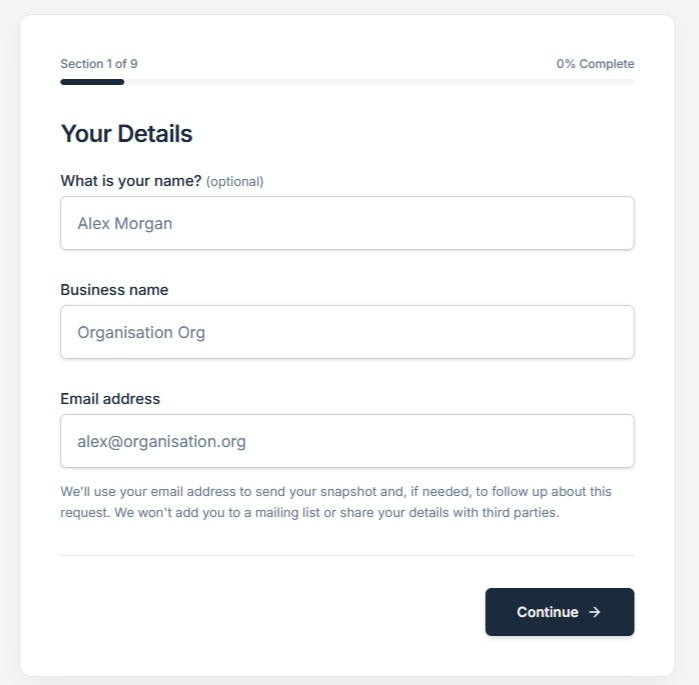
Users are asked to focus on one process that they would most like to improve over the next few months.
They then answer a short set of questions about:
- what the process is,
- what it is trying to achieve,
- how often it happens,
- where time, friction or risk currently sit,
- which systems or tools are involved,
- how predictable or variable the process is,
- where errors would have the biggest impact.
The questionnaire takes only a few minutes to complete.
Once complete, the user receives an initial view of whether the process appears to be a strong candidate for automation or AI.
Why the results matter
The result can help organisations decide whether a process is genuinely worth improving through automation, before investing time or money.
In many cases, the output reveals whether effort is being spent in the same places repeatedly, whether delays or errors are becoming significant, and whether the process is predictable enough for automation to work well.
It can also help identify when a different intervention may be more appropriate. Some processes are repetitive, stable and well suited to automation. Others may need to be simplified, standardised or redesigned first. That is still a useful result.
The aim is not for every process to be automated, and to push every organisation towards automation. The aim is to help organisations make better decisions about where automation is likely to create value, and where it may not.
What the assessment looks at
The tool uses a structured set of questions to build a picture of how the process currently operates.
It looks at:
- process frequency,
- repetition,
- variability,
- effort,
- hand-offs,
- risk,
- impact of errors,
- operational complexity.
These factors are combined into an overall view of whether the process appears to be either well suited to automation; potentially suited, but needing more work first; or unlikely to benefit from automation in its current form.
Clarity before technology
Automation is not valuable in its own right. It creates value when it is applied to the right process, in the right way, at the right time.
The Automation Feasibility Snapshot is designed to help organisations make the decision of whether or not to automate more clearly.
Before investing in technology, it helps answer a more important question: Is this process actually suitable for automation?